Day 4: April 19
Today we attended the Centre for Strategic and International Studies’ Global Development Forum (to learn more about CSIS, click here: CSIS). I particularly liked this day because we had a choice in what panels we wanted to attend so we could tailor what we heard that day to areas of interest. Don’t get me wrong, I have enjoyed the past two days and the talks that we have heard, but it’s nice to have some choice and really delve into the areas that I am interested in.

Before the individual panels began, there was an opening panel and a keynote address. The opening panel consisted of Nadia Schadlow (US Deputy National Security Advisor), Zamira Kanapyanova (Chevron), Laura Frigenti (Director, Italian Agency for International Cooperation), Donna Sims Wilson (President, Smith, Graham & Co and Investment Advisors, Chair-Elect of NASP), and Ulla Tornaes (Minister, Development Cooperation, Ministry of Foreign Affairs Denmark). This opening panel was titled “From Billions to Trillions” and the main take away was that the public sector, international institutions and governments cannot fund and provide all the aid and development needed to alleviate poverty and truly help developing countries. The funds need to go from billions (which is what the public sector pays) to trillions with the inclusion and involvement of the private sector. Aid and development can be profitable. It is not a cash dump with zero return. In order to get the money that the world needs, private corporations need to start getting involved.
One example that we were given was from Donna Sims Wilson. She informed the forum that her investment group has invested many pensions funds into infrastructure projects in Africa and are seeing returns. Although the private sector may not fully act through altruism, there are benefits to both parties involved and this needs to be shared amongst the private sector community in order to get the investment and aid from billions to trillions.
The keynote address was given by Senator Christopher Coons (Delaware). Senator Coons talked a lot about the BUILD Act, which is an act that he is sponsoring in the Senate that will modernize the way that the US does development in scope (use direct foreign investment (DFI) to mobilize capital & capacity), the tools they use, and in order to meet the competition (i.e. China’s large investments in Africa). Additionally, the bill will increase the Overseas Private Investment Cooperation‘s (OPIC – a self-sustaining US government agency that helps American businesses invest in emerging markets) fund from $29 billion to $60 billion and opens up the toolbox that OPIC can work from. Senator Coons also remarked that CEOS have said the African continent is the #1 investment opportunity, echoing Donna Sims Wilson’s remarks.
You can listen to the opening remarks, keynote and panel here.
Next was the breakout individual panels.

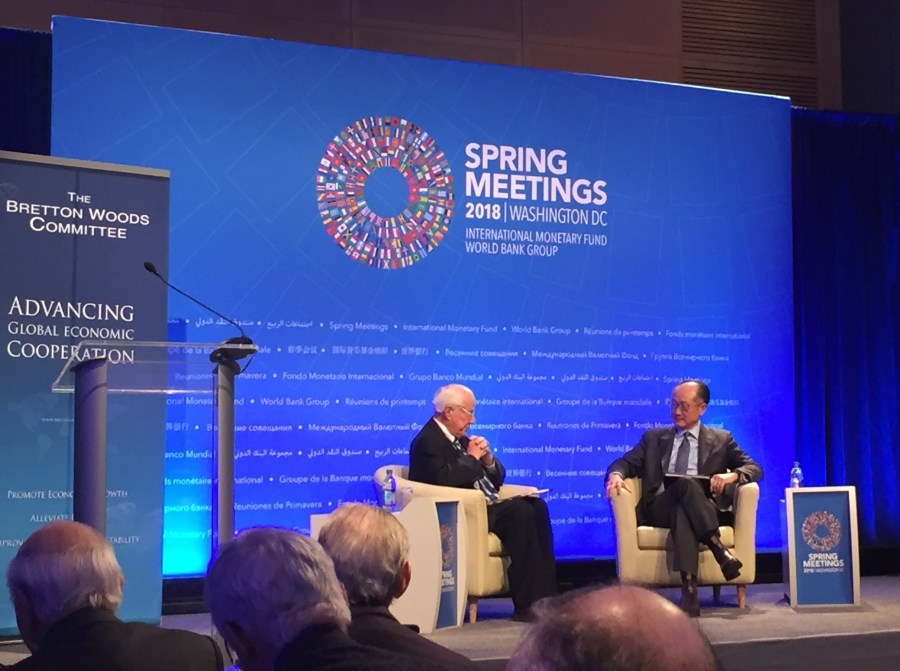
Senator Coons
The forums that I was interested in were: “Creating a Domestic Consensus on Development: Perspectives from Western Allies” and “The Global Forced Migration Process – A European Perspective”.
I chose to attend the “Global Forced Migration Process” panel because I have recently turned my academic interests towards migration and refugee movements. (You’ll hear more about these interests later when I reach the Maldives). I chose to attend the “Creating a Domestic Consensus” panel because when I originally read through the options, I thought this panel was going to talk about how the Western allies believe that development should be done in countries that are receiving development and aid. I’m critical of development and aid programs that do not include large consultation with the government and the people of the country and do not include being on the ground and seeing with one’s own eyes what the issues are and hearing the opinions and ideas of the people on how things could be improved.
I understand that this might seem impossible or silly for development and aid programs given by the IMF and World Bank, or you may argue back that the country that is receiving aid, their government is involved in the negotiation of the aid program and therefore consultation is done. But in my opinion, based on personal experience in developing countries, listening to the people, liberation theology learned in classes and personal readings, having domestic consultation and inclusion is of VITAL importance; otherwise the project is meaningless and in the end won’t do any good.
There has recently been a splurge in what is called “Volun-tourism” – where one travels to a different country, volunteers in helping out at a school, or construction projects etc. If these programs are genuine, and done with the consultation of the local people and actually create a difference, then GREAT! But I’ve also heard of stories where a voluntourism group comes in and paints a church and then they leave thinking they’ve done something good. Only, a little while later, another group comes in and paints the same church. This isn’t helping the local people, and I believe it creates a false sense of altruism.
But enough about my personal beliefs, let’s get into what was discussed!
I ended up being completely wrong about what the “Creating a Domestic Consensus on Development” was going to be about. I walked in prepared to criticize and argue against Western-based plans and programs for developing countries, but it turned out that the panel was actually about how Western countries convince their citizens that development and aid programs and funding are important. This is an important question because with the global rise of nationalism, populism and anti-democratic forces rising coupled with the largest migration crisis since WWII, people are questioning global aid and development norms that have been ongoing for the last 70+ years and how it has benefitted them. The western countries represented at this panel were the United States, Japan, Germany and Britain. This is how each country’s representative explained their ‘tactics’ on creating a consensus.
United States: Emphasizes that aid is in American national and economic interests:
– development is cheaper than sending in soldiers
– if you cut aid funding, you will need to increase funding for ammunition
– 11/15 top US trading partners used to be aid recipients (i.e. Japan & Germany)
– terrorism and infectious diseases could come to America, but aid helps defeat this
Japan: Public opinion drives policy and is the justification of ODA:
– 2015: Development Cooperation Charter, consisted of 4 meetings for businesses, NGOs, academics, the media, etc. to give recommendations to the government
– helps increase global views of Japan
– helps Japan economically because it broadens Japan’s footprint in the world
Britain: Rule of 0.7% of Gross National Income spent on aid
– keeping the promise of 0.7%/GNI spent on aid helps with soft power
– Law that if the Minister doesn’t spend 0.7%, (s)he needs to explain why to Parliament
– previously looked at aid through trade, but then a whole department was made +2000 Millenium Development Goals helped drive aid agenda
– 2010: all major parties committed to spending 0.7% on aid, despite during a time of austerity; “won’t balance the books on the backs of the poorest” (kept spending levels of health and aid the same)
– $$$ isn’t a blank cheque, you need to show outcomes & anything given over 500 pounds is reported on a government website
– promise to not do anything the receiving governments don’t want
– 1/3 country support aid, 1/3 country against aid, 1/3 country marginally engaged
Germany: Past helped determine the current and future
– after WWII, Germany received aid through the Marshall Plan, so from the beginning, aid was a welcomed effort
– 1961: Ministry of Foreign Assistance was established
– 2013: Change came to the policy because of the refugee crisis (~1,000,000 refugees entered in 2015); needed a policy of means and one that would create stabilization
– foreign assistance is now seen as an interest to Germany, and not just altruistic
My take away question: Does the history of colonization and imperialism impact current day development projects?
My afternoon panel, “The Global Forced Migration Crisis” focused on how Europe has responded to the migration crisis with representatives from the EU Embassy, Migration Policy Institute Europe, UN International Migration Office and the Centre for Global Development. The Background: from 2013-2016, 3 million people applied for asylum in the EU. So far for 2018, 16,000 people have crossed the Mediterranean with 500 people dying along the journey. In 2017, 171,000 people crossed and 3,100 perished. How have the question of immigration impacted EU’s politics?
EU Embassy:
– this isn’t a short-term issue
– purpose of migration can be because of forced displacement or economical
– need to be conscious of the mix between a) commitment to international refugees and displaced people, b) EU demographic issues (need migrants), c) politically sensitive issue and while there are xenophobes there can be genuine concerns so can’t dismiss rhetoric
– the crisis was handled on a national level (i.e. Italy and Greece) instead of a continental level and this isn’t working, but there are tensions with sovereign nations not wanting to give authority to the EU to act
– need more states, order and coordination for receiving refugees
*need to reform common European asylum system as currently, it puts the most burden on countries of the first receipt
*need to improve legal pathways
*need to address root causes (find the political process for what’s causing migration/invest in countries who face economic migration and lack of opportunities)
– the challenge of the country of the first instance, as many refugees want to end up somewhere else
Migration Policy Institute Europe:
– the migration crisis has become a transboundary crisis
– the EU was not set up to be an operational actor
– the EU isn’t a governing state, it needs permission to act in sovereign states and there wasn’t a clear narrative on how to respond and this led to the conversation of whether borders should be opened or closed
– no migration coordinator to lead the response and little coordination between portfolios
– most of the crisis happened in August and this was when Brussels (where the EU sits) was out of session
– $$$ doesn’t always translate into resources & some countries didn’t want to contribute $$$ because they wanted to keep autonomy
– How can the EU become a crisis responder?
– reception capacity and length of asylum procedures need to be improved
– Game Theory: once you get good at asylum, no one will want to go anywhere else
– the creation and values of the Shenegan agreement have changed, and there needs to be a 2.0
UN International Migration Office:
– to develop effective policies, you need to know what you are developing them for (i.e. forced migration, refugee asylum, irregular/illegal migration, general migration)
– an area with binary discourse, i.e. refugee vs. economic, forced vs. voluntary, regular vs. irregular, legal vs. illegal
– forced migration is not the only vulnerability, exploited labour
– need to take a humanitarian viewpoint first!
– need to reduce the necessity in which people migrate
– need to expand the legal pathways – the more you normalize migration the less you’ll see irregular migration
– migration demands international cooperation
Centre for Global Development:
– the burden is still mostly on frontline states
– German took in 1 million, Turkey 3 million and Yemen 1.5 million when their initial population was only 6 million, so their population increased by 25%
– rhetoric matters! There is a notion of invasion (i.e. flood, tide) and this create a nation of fear
– there is a link between aid policy and people’s propensity to migration -> development aid is probably only useful in the 30-40 year timeline and not the 5-10 year timeline
– ability to migrate increases as GDP increases, so aid could perpetuate this
– global conflict resolution mechanisms have been fairly lacking in recent years
– the World Bank is helping capacitate frontline states
– optimistic that in 5-10 and 10-20 years, public opinion will change from the current nationalism/populism/anti-democratic (i.e. Brexit, Trump) because of the generational divide but can we hold together these political institutions until this happens?
My take away reflection: You can be labelled a refugee without having been forcibly removed from your country – climate change and environmental refugees.
This is definitely one of my longer posts. If you made it all the way to the end, thank you! And I hope you enjoyed what I took away from this day and learned something yourself.
Until next time!

 Anne Marie's Adventures