Day 2: April 17
So what am I doing here in DC? Well, the University of Waterloo’s Political Science department is offering an experiential learning course through a field study at the International Monetary Fund (IMF) and World Bank Spring 2018 Meetings. We partnered with a CSO called New Rules for Global Finance and work as Fellows. This is an amazing opportunity to see first hand the questions and some answers that lead policy and programs and a great networking opportunity. So….here it goes:
Today marked the beginning of a series of extremely interesting and intellectually stimulating talks and discussions that we would attend. We started at the Brooking’s Institute (a non-profit public policy organization) with a talk entitled “Digital Currencies: Implications for Central Banks”.
What is a digital currency? The first thing that will probably pop into your mind, and which also popped into mine, is Bitcoin; but digital currencies are much more than that, and ask discussed in this talk, are going to be huge implications for Central Banks going forward.
The talk began with a presentation from Dr Eswar Prasad presenting his latest paper entitled “Central Banking in a Digital Age: Stock-Taking and Preliminary Thoughts” (https://www.brookings.edu/wp-content/uploads/2018/03/es_20180416_digitalcurrencies_final.pdf). This was followed by a moderated discussion (Rana Foroohar) with three central bankers from across the world: Stefan Ingves (Governor, Sveriges Riksbank), Urjit R. Patel (Governor, Reserve Bank of India) and Agustin Carstens (General Manager, Bank of International Settlements).
While all four panellists concurred that the role of central banks, and the societal contract of what banking is and the trust involved in exchanging currencies, are still crucial institutions and will continue to function, they did acknowledge that the banks will have to innovate and update in order to work in the world of digital currencies.
Beyond Bitcoin, some countries (including Venezuela, Tunisia and Senegal) have already created an e-currency, and they, as well as the international financial system as a whole, will have to come together to create a new set of rules, and potentially even a new social contract around the idea of what is money.
If you want to hear the discussion, click this link: Digital Currencies: Implications for Central Banks

From L-R: Foroohar, Ingves, Patel, Carstens and Prasad
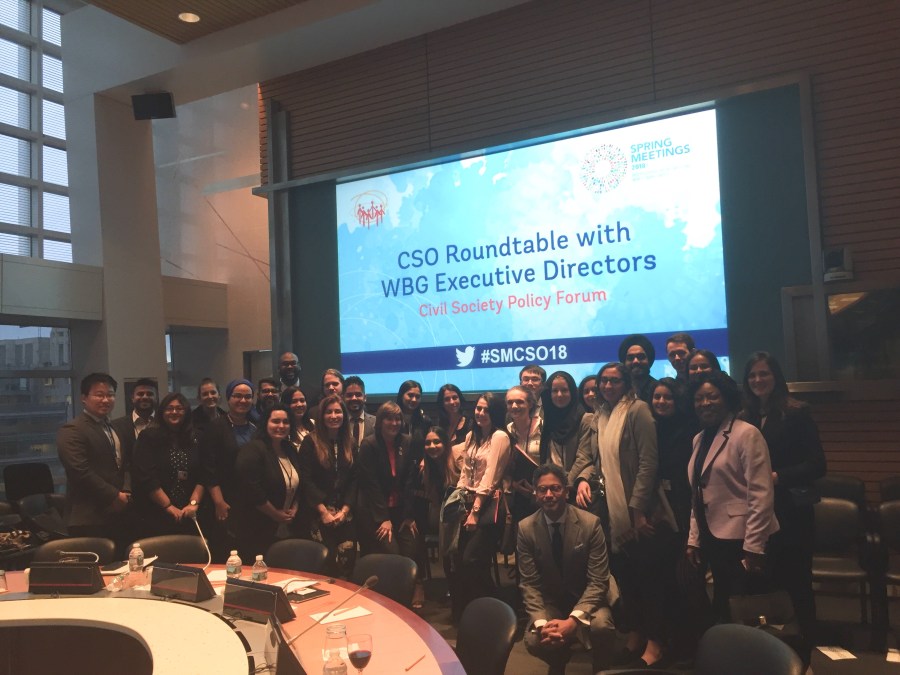
The second discussion of the day was the Civil Society Roundtable with the World Bank Group Executive Directors. In total, the World Bank has 25 Executive Directors. Some directors represent only a single country, while others represent a coalition of countries. For instance, Canada’s Executive Director, Christine Hogan, also represents Ireland and the Caribbean. During this roundtable the executive directors and other high ranking staff were available to answer civil society’s questions on a number of topics: health, education & workforce development, Accountability, Good Governance & Role of CSOs, Gender & Sexuality, Disability & Inclusion, Environment & Climate Change and Democracy, Civic Engagement & Human Rights.
After the roundtable, we were lucky enough to be introduced to Canada’s ED Christine Hogan and take a picture with her (near the middle, redshirt under a black blazer). A critique we had during the week is we found a severe lack of female representation on all of the panels. So seeing a woman in such a high ranking position, answering questions extremely well and being interest and engaged not only with our group but with all the CSOs was really amazing and empowering to see and experience; because representation matters!
To learn more about the Civil Society Policy Forum, click here: Civil Society Policy Forum
 Anne Marie's Adventures