Last Day of Spring Meetings, First Day of Exploring DC!

Day 6: April 21

I can’t believe that this was the last day of the Spring Meetings!!! It was so jammed packed but it also flew by!!! The last five days have just been a whirlwind for my brain and reignited my passion and interest in development!

Today’s panel was entitled Building Human Capital: A Project for the World. While I was unable to attend this panel in person (hooray for aggravating my back injury), the above link will let you (and me) hear what the panellist had to say. And guess who one of the panellists were??????

BILL GATES!!!!!!!  MICROSOFT BILL GATES! BILL & MELINDA GATES FOUNDATION BILL GATES!!!!

I’ve seen and listened to so many amazing, admirable and insanely knowledgeable people during these meetings. That just in itself has made this trip worthwhile.

After that panel, we met with Adam Moscoe. Adam is currently working as an Advanced Policy Analyst Program with Finance Canada. Adam completed his B.A. and M.A. at the University of Ottawa, and through the Young Diplomats of Canada program met our professor. Since then they have exchanged tweets and she invited Adam to speak to us about becoming a public servant, his experience and suggestions for us as we enter the working world after graduation. Although our time with Adam was short, it was very inciteful, and he was gracious enough to give us his contact information if we had anymore follow up questions.

And that was the end of the Spring Meetings! Now, it was time to explore D.C.

My friends Jessica, Iqra and I started our afternoon eating at our favourite pizza place, &Pizza (which just so happened to be attached to the hotel I was staying at). Honestly, this is one of the BEST pizzas I’ve had. Just see for yourself:

IMG_0308

After pizza, we headed to the Smithsonian’s newest museum: The National African American History and Culture Museum. This is such a popular museum!! The museum is free just like all of the other Smithsonian museums, however, you require a timed ticket. These need to be acquired months in advance (at the end of March I was trying to get a ticket, and the next available tickets were for July). Thankfully, the museum does release same-day tickets. The catch is they are released at 6:30 am and go in a heartbeat. Iqra was a doll and woke up in the wee hours to get our tickets. IT WAS 100% WORTH IT!

IMG_1397

I was so intrigued by all the information and exhibits that I completely forgot to take any pictures at the museum. The museum is separated into two different parts. There are three stories tracing the history of African Americans in the United States from slavery to present day and the trials, tribulations, setbacks, successes, rights granted and spirit they went through and endeared. The second part of the museum is a number of galleries featuring art from African American artists. I, unfortunately, didn’t get to see much of this second part of the museum because I had tickets to the Kennedy Centre for the Performing Arts!

IMG_0311

This show is a hilarious Who-Done-It Murder Mystery. The first act of the show goes as any other theatre production would. But then in the second act, they brake the four wall, and us audience members play the role of detective and decide who is the murder. In addition to producing outstanding art, the Kennedy Centre also has a gorgeous view of D.C. and Georgetown. I’ve compiled pictures below.

After the show I returned to my hotel and packed up, tomorrow I’m checking out and checking into an Airbnb-Hostel to start the second phase of the D.C. lag of my trip.

Can’t wait to tell you what I got up to next!

Debt, Growth & Implications for the Current and Future Economy

Day 5: April 20

Today we were back at the IMF and World Bank headquarters to hear talks regarding debt and growth in developing countries. What I really appreciated about these talks is that they actually had representatives from developing countries that are economically growing while taking on debt. It wasn’t just the “wise” western European countries.

The first panel was titled Debt & Growth: A Balancing Act? It was really interesting to hear the different ways that developing and emerging countries are using debt to push growth and create economic change. The following is a summary of my major takeaways from each panellist:

Kenneth Ofori-Atta: Finance Minister, Ghana:
– 
In recent years, Ghana’s financial situation has not been stable and they have borrowed billions of funds, but the country is starting to turn this around
– Debt/GDP 2016 = 73%, 2017 = 69.5%
– Since 2003 the country has been running a primary deficit, but this changed last year
– 2009 debt stock = $9 Billion, 2016 = $30 Billion
– the country didn’t come to the international markets last year in order to take stock of their debt
– the challenge to the recent improvements in the country’s financial situation is making these improvements and changes irreversible if/when a new government comes in
– has reduced the budget deficit from 9.3% -> 5.9&, and growth has risen from 3.7% to 8.5%
– there is a balancing act between being fiscally disciplined while also creating growth
– 4% of GDP is interest payments and this needs to change

Matthew Rycroft: Permanent Secretary, Department for International Development, United Kingdom:
– 
debt isn’t an obstacle to growth, certain debt (quality & structure) is an important step to growth
– a new trend of South-to-South lending
– borrowing countries need to be transparent with the international community and their citizens
– suggested lenders to use the G20 Guidelines for Sustainable Financing
– lending mechanisms need to adapt to an increased number of financing options increase

Imad Fakhoury: Minister of Planning & International Cooperation, Jordan:
– 
The country’s Debt/GDP increased, but not because of financial mismanagement, but because of external shocks (i.e. the Arab Spring and taking in refugees)
– to account for these shocks and the impacts on the country’s economic and financial system, the country:
– implemented strong fiscal programs that cut ALL subsidies
– turned the refugee crisis into a development opportunity — pushed for a global public good that warrants new spending for middle-income countries*
– resumed development and growth agenda
*- instead of turning refugees away and closing Jordan’s border in order to protect its economy, the country did the right thing of letting the refugees in. Jordan brought to light the fact that middle-income countries are surrounded by conflict and take in an increased amount of refugees compared to developed high-income countries. Minister Fakhoury asked the question: What kind of world todo we want to create? This let to incentivizing countries to bring refugees in instead of closing borders and being protectionist

Torsten Slok: Chief International Economist – Managing Director, Deutsche Bank Securities, Inc.
– after the 2008 Global Recession, interest rates in the United States, Europe and Japan were at ~0%, there was a hunt for yield around the world that led to developing and emerging countries to receive an influx of investments since interest rates were low. But what happens when interest rates start to increase?
– Investors are about to re-assess risk and how they buy in the future. This will result in developing countries and emerging markets to receive funding as risk-free investments interest rates increase
– Countries that issued long-term bonds (i.e. 50 years) was very clever
– Why isn’t the US dollar increasing while interest rates increase??
– EU countries that had debt issues had higher income countries help bail them out. Developing and emerging economy countries don’t have this ability.

Mauricio Cardenas: Minister of Finance & Public Credit, Republic of Columbia:
– 
debt is relative to your own GDP, make sure you accelerate growth as you borrow
– need to ensure that what you borrow is sustainable, that you give pay back your loans but the debt also gives you dividends
– COMPOSITION OF DEBT MATTERS: borrow in the currency you have, debt in foreign currency is a huge risk
– ensure the debt you are taking on isn’t funding current expenditures (this is the responsibility of institutions in your country) and instead funding new investments
– Columbia is also facing the economic stresses of taking in refugees (~700,000 Venezuelans in Columbia with ~45,000 crossing/day)
– wants continued access to multilateral deals/relationships
– a national law that Columbia can only borrow 3% of GDP
– Columbia lost 1/2 of its exports with the price of oil dropping, but this hasn’t resulted in a recession because having a flexible exchange rate has been a key and first line of defence. This flexible exchange rate is possible because the country hasn’t borrowed much in foreign currency

img_0274.jpg

The second meeting of the day was entitled “Global Renewal: Debt Relief & Financial Investment towards a Sustainable Future”. The panel included representatives from the IMF, Jubilee-Puerto Rico, AFRODAD and EURODAD. My big take away from these representatives included:

  • IMF Low-Income Country Report: 50% of countries have debt: GDP levels of +50%. The median country in this list has a debt: GDP level of +60%
  • the creditor structure has changed from banks and the Paris Club to commercial creditors and regional/plurilateral lenders
  • 8% of countries globally meet standards in debt coverage and transparency
  • Before the 2017 hurricane season, Puerto Rico had a public debt of $72 billion, pension plans were at zero, 60% of children are in poverty, 12% unemployment and there is mass migration to mainland United States
  • In 2016, PR government declared debt unpayable, but a 2013 law doesn’t allow PR to declare bankruptcy
  • The African continent has received two previous debt relief programs (1996: Heavily Indebted Poor Countries Initiative, 2005: Multilateral Debt Relief Initiative)
  • African countries that have graduated to middle-income status can no longer access concessional loans, so they are now going to new sources of financing. Additionally, many countries will be seeking refinancing options as they will not be able to pay back the debt owed this year
  • Public-Private Partnerships are becoming more popular
  • Creation of the African Borrowing Charter
    • sustain debt levels
    • transparency and accountability
    • debt borrowing needs to happen within a constitutional and legal framework
    • disclosure and publications
    • avoid incidents of over-borrowing
  • AFRODAD will now push for governments to adopt this charter
  • 2014: commodity prices dropped almost 50%, and despite this, the lending boom continued to developing countries. The US and EU quantitative easing policies led to these lending booms.
  • Need to look at lending and borrowing from a human rights perspective!
  • clauses can be added to bonds that can change debt payments and restructure debt if an external shock happens (i.e. natural disasters”. Need the “use of state-contingent debt instruments’
  • UNHCR: Principles of Debt and Human Rights


For further information on topics and publications listed, please visit:

AFRODAD Borrowing Charter
Development of guiding principles for assessing the human rights impact of economic reform policies and its mandate
Puerto Rico’s Debt Crisis

MY PERSONAL FAVOURITE:

Lin-Manuel Miranda, creator of Hamilton the Musical and In the Heights, appeared on John Oliver’s Last Week Tonight and concluded Oliver’s monologue with a rap, pleading Congress to help Puerto Rico’s Debt Crisis. (Link 1 and Link 2).

Additionally, after the tragic effects of Hurricane season on Puerto Rico, and lack of support given from the US government, Miranda and many other Puerto Rican and Latinx artists joined together to create the song “Almost Like Praying (featuring Artists for Puerto Rico)”. All proceeds from this song go to help Puerto Rico rebuild. I urge you to go onto iTunes and purchase this song. Not only is it for a good cause, but it’s a good song!!!

img_0281.jpg


Centre for Strategic and International Studies

Day 4: April 19

Today we attended the Centre for Strategic and International Studies’ Global Development Forum (to learn more about CSIS, click here: CSIS). I particularly liked this day because we had a choice in what panels we wanted to attend so we could tailor what we heard that day to areas of interest. Don’t get me wrong, I have enjoyed the past two days and the talks that we have heard, but it’s nice to have some choice and really delve into the areas that I am interested in.

img_0254.jpg

Before the individual panels began, there was an opening panel and a keynote address. The opening panel consisted of Nadia Schadlow (US Deputy National Security Advisor), Zamira Kanapyanova (Chevron), Laura Frigenti (Director, Italian Agency for International Cooperation), Donna Sims Wilson (President, Smith, Graham & Co and Investment Advisors, Chair-Elect of NASP), and Ulla Tornaes (Minister, Development Cooperation, Ministry of Foreign Affairs Denmark). This opening panel was titled “From Billions to Trillions” and the main take away was that the public sector, international institutions and governments cannot fund and provide all the aid and development needed to alleviate poverty and truly help developing countries. The funds need to go from billions (which is what the public sector pays) to trillions with the inclusion and involvement of the private sector. Aid and development can be profitable. It is not a cash dump with zero return. In order to get the money that the world needs, private corporations need to start getting involved.

One example that we were given was from Donna Sims Wilson. She informed the forum that her investment group has invested many pensions funds into infrastructure projects in Africa and are seeing returns. Although the private sector may not fully act through altruism, there are benefits to both parties involved and this needs to be shared amongst the private sector community in order to get the investment and aid from billions to trillions.

The keynote address was given by Senator Christopher Coons (Delaware). Senator Coons talked a lot about the BUILD Act, which is an act that he is sponsoring in the Senate that will modernize the way that the US does development in scope (use direct foreign investment (DFI) to mobilize capital & capacity), the tools they use, and in order to meet the competition (i.e. China’s large investments in Africa). Additionally,  the bill will increase the Overseas Private Investment Cooperation‘s (OPIC – a self-sustaining US government agency that helps American businesses invest in emerging markets) fund from $29 billion to $60 billion and opens up the toolbox that OPIC can work from. Senator Coons also remarked that CEOS have said the African continent is the #1 investment opportunity, echoing Donna Sims Wilson’s remarks.

You can listen to the opening remarks, keynote and panel here.

Next was the breakout individual panels.

senator coons

Senator Coons

The forums that I was interested in were: “Creating a Domestic Consensus on Development: Perspectives from Western Allies” and “The Global Forced Migration Process – A European Perspective”.

I chose to attend the “Global Forced Migration Process” panel because I have recently turned my academic interests towards migration and refugee movements. (You’ll hear more about these interests later when I reach the Maldives). I chose to attend the “Creating a Domestic Consensus” panel because when I originally read through the options, I thought this panel was going to talk about how the Western allies believe that development should be done in countries that are receiving development and aid. I’m critical of development and aid programs that do not include large consultation with the government and the people of the country and do not include being on the ground and seeing with one’s own eyes what the issues are and hearing the opinions and ideas of the people on how things could be improved.

I understand that this might seem impossible or silly for development and aid programs given by the IMF and World Bank, or you may argue back that the country that is receiving aid, their government is involved in the negotiation of the aid program and therefore consultation is done. But in my opinion, based on personal experience in developing countries, listening to the people, liberation theology learned in classes and personal readings, having domestic consultation and inclusion is of VITAL importance; otherwise the project is meaningless and in the end won’t do any good.

There has recently been a splurge in what is called “Volun-tourism” – where one travels to a different country, volunteers in helping out at a school, or construction projects etc. If these programs are genuine, and done with the consultation of the local people and actually create a difference, then GREAT! But I’ve also heard of stories where a voluntourism group comes in and paints a church and then they leave thinking they’ve done something good. Only, a little while later, another group comes in and paints the same church. This isn’t helping the local people, and I believe it creates a false sense of altruism.

But enough about my personal beliefs, let’s get into what was discussed!

I ended up being completely wrong about what the “Creating a Domestic Consensus on Development” was going to be about. I walked in prepared to criticize and argue against Western-based plans and programs for developing countries, but it turned out that the panel was actually about how Western countries convince their citizens that development and aid programs and funding are important. This is an important question because with the global rise of nationalism, populism and anti-democratic forces rising coupled with the largest migration crisis since WWII, people are questioning global aid and development norms that have been ongoing for the last 70+ years and how it has benefitted them. The western countries represented at this panel were the United States, Japan, Germany and Britain. This is how each country’s representative explained their ‘tactics’ on creating a consensus.

United States: Emphasizes that aid is in American national and economic interests:
– development is cheaper than sending in soldiers
– if you cut aid funding, you will need to increase funding for ammunition
– 11/15 top US trading partners used to be aid recipients (i.e. Japan & Germany)
– terrorism and infectious diseases could come to America, but aid helps defeat this

Japan: Public opinion drives policy and is the justification of ODA:
– 2015: Development Cooperation Charter, consisted of 4 meetings for businesses, NGOs, academics, the media, etc. to give recommendations to the government
– helps increase global views of Japan
– helps Japan economically because it broadens Japan’s footprint in the world

Britain: Rule of 0.7% of Gross National Income spent on aid
– keeping the promise of 0.7%/GNI spent on aid helps with soft power
– Law that if the Minister doesn’t spend 0.7%, (s)he needs to explain why to Parliament
– previously looked at aid through trade, but then a whole department was made +2000 Millenium Development Goals helped drive aid agenda
– 2010: all major parties committed to spending 0.7% on aid, despite during a time of austerity; “won’t balance the books on the backs of the poorest” (kept spending levels of health and aid the same)
– $$$ isn’t a blank cheque, you need to show outcomes & anything given over 500 pounds is reported on a government website
– promise to not do anything the receiving governments don’t want
– 1/3 country support aid, 1/3 country against aid, 1/3 country marginally engaged

Germany: Past helped determine the current and future
– after WWII, Germany received aid through the Marshall Plan, so from the beginning, aid was a welcomed effort
– 1961: Ministry of Foreign Assistance was established
– 2013: Change came to the policy because of the refugee crisis (~1,000,000 refugees entered in 2015); needed a policy of means and one that would create stabilization
– foreign assistance is now seen as an interest to Germany, and not just altruistic

My take away question: Does the history of colonization and imperialism impact current day development projects?

My afternoon panel, “The Global Forced Migration Crisis” focused on how Europe has responded to the migration crisis with representatives from the EU Embassy, Migration Policy Institute Europe, UN International Migration Office and the Centre for Global Development. The Background: from 2013-2016, 3 million people applied for asylum in the EU. So far for 2018, 16,000 people have crossed the Mediterranean with 500 people dying along the journey. In 2017, 171,000 people crossed and 3,100 perished. How have the question of immigration impacted EU’s politics?

EU Embassy:
– this isn’t a short-term issue
– purpose of migration can be because of forced displacement or economical
– need to be conscious of the mix between a) commitment to international refugees and displaced people, b) EU demographic issues (need migrants), c) politically sensitive issue and while there are xenophobes there can be genuine concerns so can’t dismiss rhetoric
– the crisis was handled on a national level (i.e. Italy and Greece) instead of a continental level and this isn’t working, but there are tensions with sovereign nations not wanting to give authority to the EU to act
– need more states, order and coordination for receiving refugees
*need to reform common European asylum system as currently, it puts the most burden on countries of the first receipt
*need to improve legal pathways
*need to address root causes (find the political process for what’s causing migration/invest in countries who face economic migration and lack of opportunities)
– the challenge of the country of the first instance, as many refugees want to end up somewhere else

Migration Policy Institute Europe:
– 
the migration crisis has become a transboundary crisis
– the EU was not set up to be an operational actor
– the EU isn’t a governing state, it needs permission to act in sovereign states and there wasn’t a clear narrative on how to respond and this led to the conversation of whether borders should be opened or closed
– no migration coordinator to lead the response and little coordination between portfolios
– most of the crisis happened in August and this was when Brussels (where the EU sits) was out of session
– $$$ doesn’t always translate into resources & some countries didn’t want to contribute $$$ because they wanted to keep autonomy
– How can the EU become a crisis responder?
– reception capacity and length of asylum procedures need to be improved
– Game Theory: once you get good at asylum, no one will want to go anywhere else
– the creation and values of the Shenegan agreement have changed, and there needs to be a 2.0

UN International Migration Office:
– to develop effective policies, you need to know what you are developing them for (i.e. forced migration, refugee asylum, irregular/illegal migration, general migration)
– an area with binary discourse, i.e. refugee vs. economic, forced vs. voluntary, regular vs. irregular, legal vs. illegal
– forced migration is not the only vulnerability, exploited labour
– need to take a humanitarian viewpoint first!
– need to reduce the necessity in which people migrate
– need to expand the legal pathways – the more you normalize migration the less you’ll see irregular migration
– migration demands international cooperation

Centre for Global Development:
– the burden is still mostly on frontline states
– German took in 1 million, Turkey 3 million and Yemen 1.5 million when their initial population was only 6 million, so their population increased by 25%
– rhetoric matters! There is a notion of invasion (i.e. flood, tide) and this create a nation of fear
– there is a link between aid policy and people’s propensity to migration -> development aid is probably only useful in the 30-40 year timeline and not the 5-10 year timeline
– ability to migrate increases as GDP increases, so aid could perpetuate this
– global conflict resolution mechanisms have been fairly lacking in recent years
– the World Bank is helping capacitate frontline states
– optimistic that in 5-10 and 10-20 years, public opinion will change from the current nationalism/populism/anti-democratic (i.e. Brexit, Trump) because of the generational divide but can we hold together these political institutions until this happens?

My take away reflection: You can be labelled a refugee without having been forcibly removed from your country – climate change and environmental refugees.


This is definitely one of my longer posts. If you made it all the way to the end, thank you! And I hope you enjoyed what I took away from this day and learned something yourself.

Until next time!

Seeing the Institutions at Work

Day 3: April 18

Today consisted of three different the panels. The first was titled “Economies in Transition: Inequality and IMF Policies in the Middle East and North Africa (MENA). This was a very interesting panel as it consisted of representatives from different CSOs presenting a critique of IMF programs that have been implemented in their countries, including Lebanon and Egypt, among others. It was interesting to hear these critiques and understand that there isn’t a single mould program that can apply to each country. It is a case by case basis and ones that need to be reviewed and tweaked when needed. Certainly a reminder that it is always important to review, change and innovate.

img_0236.jpg

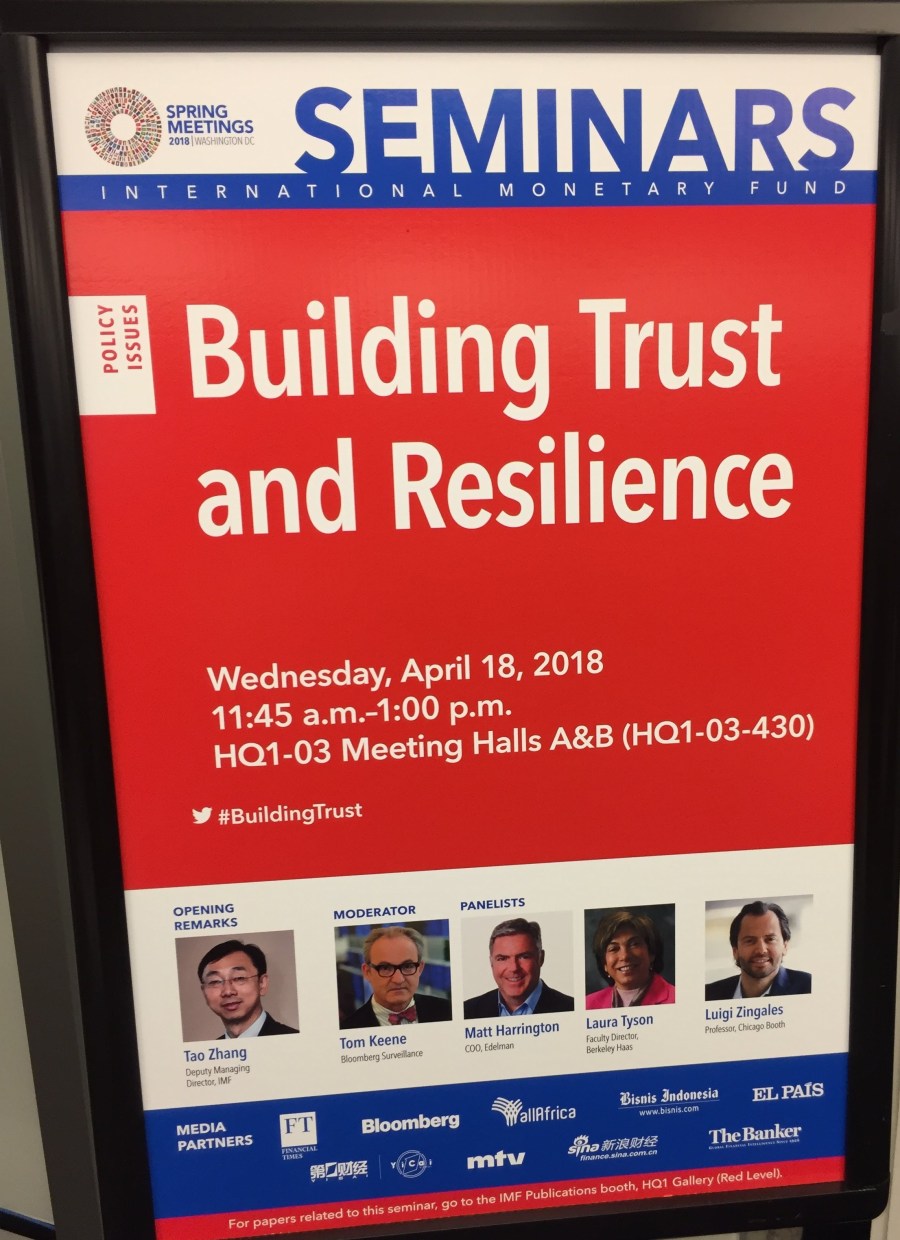
The second panel was entitled Building Trust and Resilience. I found this panel to be a good contrasting supplement to the previous panel. It also reflected on the needs of the national community and economic system to be able to respond and work through shocks in the system, and the trust needed from the people to institutions in order this to happen successfully. You can find the webcast for the seminar here: Building Trust & Resilience

img_0240.jpg

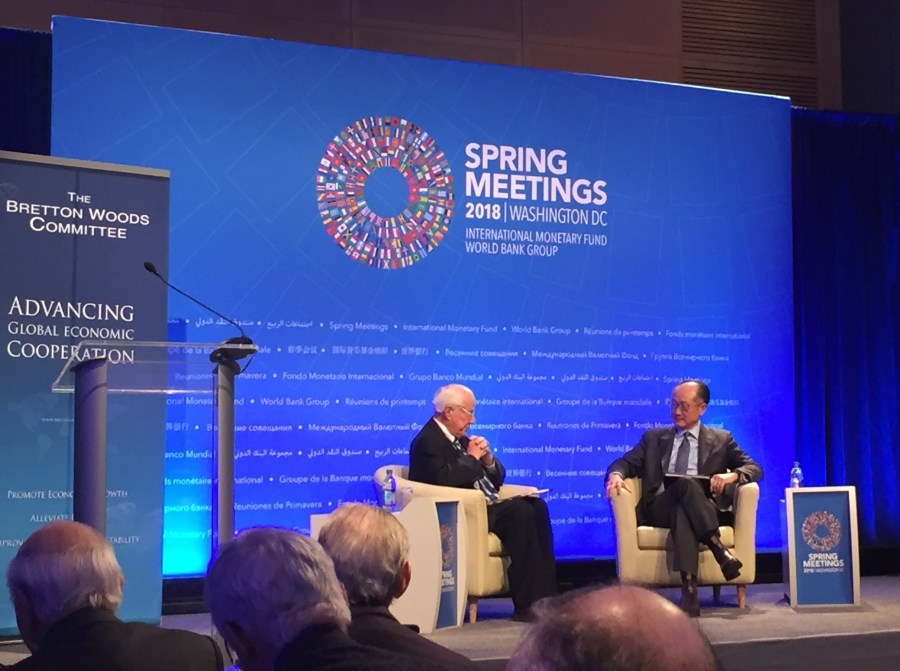
Last, but certainly not least, was the Bretton Woods 2018 Annual Meeting. This meeting consisted of multiple panels filled with extraordinary people from a diverse range of institutions. A definite highlight for me was hearing World Bank President Jim Yong Kim (pictured below) speak about the successes of the World Bank, challenges that lay ahead, and programs they are about to release. Hearing views from institutions including IMF, Inter-American Development Bank, Asian Infrastructure Investment Bank and the Overseas Private Investment Corporation. I’ve studied these institutions in class and to hear in person their thought and actions towards today’s global economic problems, was a fantastic experience. Click here to find out more about the Bretton Woods Committee

img_0248.jpg

The Spring Meetings Begin

Day 2: April 17

So what am I doing here in DC? Well, the University of Waterloo’s Political Science department is offering an experiential learning course through a field study at the International Monetary Fund (IMF) and World Bank Spring 2018 Meetings. We partnered with a CSO called New Rules for Global Finance and work as Fellows. This is an amazing opportunity to see first hand the questions and some answers that lead policy and programs and a great networking opportunity. So….here it goes:

Today marked the beginning of a series of extremely interesting and intellectually stimulating talks and discussions that we would attend. We started at the Brooking’s Institute (a non-profit public policy organization) with a talk entitled “Digital Currencies: Implications for Central Banks”.

What is a digital currency? The first thing that will probably pop into your mind, and which also popped into mine, is Bitcoin; but digital currencies are much more than that, and ask discussed in this talk, are going to be huge implications for Central Banks going forward.

The talk began with a presentation from Dr Eswar Prasad presenting his latest paper entitled “Central Banking in a Digital Age: Stock-Taking and Preliminary Thoughts” (https://www.brookings.edu/wp-content/uploads/2018/03/es_20180416_digitalcurrencies_final.pdf). This was followed by a moderated discussion (Rana Foroohar) with three central bankers from across the world: Stefan Ingves (Governor, Sveriges Riksbank), Urjit R. Patel (Governor, Reserve Bank of India) and Agustin Carstens (General Manager, Bank of International Settlements).

While all four panellists concurred that the role of central banks, and the societal contract of what banking is and the trust involved in exchanging currencies, are still crucial institutions and will continue to function, they did acknowledge that the banks will have to innovate and update in order to work in the world of digital currencies.

Beyond Bitcoin, some countries (including Venezuela, Tunisia and Senegal) have already created an e-currency, and they, as well as the international financial system as a whole, will have to come together to create a new set of rules, and potentially even a new social contract around the idea of what is money.

If you want to hear the discussion, click this link: Digital Currencies: Implications for Central Banks

brookings institute

From L-R: Foroohar, Ingves, Patel, Carstens and Prasad

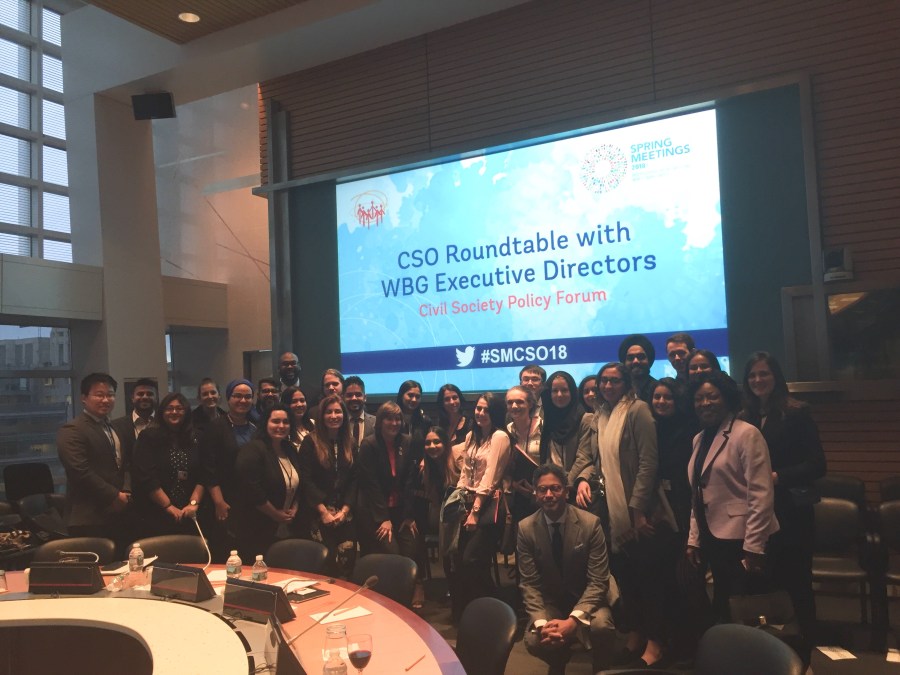
The second discussion of the day was the Civil Society Roundtable with the World Bank Group Executive Directors. In total, the World Bank has 25 Executive Directors. Some directors represent only a single country, while others represent a coalition of countries. For instance, Canada’s Executive Director, Christine Hogan, also represents Ireland and the Caribbean. During this roundtable the executive directors and other high ranking staff were available to answer civil society’s questions on a number of topics: health, education & workforce development, Accountability, Good Governance & Role of CSOs, Gender & Sexuality, Disability & Inclusion, Environment & Climate Change and Democracy, Civic Engagement & Human Rights.

After the roundtable, we were lucky enough to be introduced to Canada’s ED Christine Hogan and take a picture with her (near the middle, redshirt under a black blazer). A critique we had during the week is we found a severe lack of female representation on all of the panels. So seeing a woman in such a high ranking position, answering questions extremely well and being interest and engaged not only with our group but with all the CSOs was really amazing and empowering to see and experience; because representation matters!

canada WBG ED

To learn more about the Civil Society Policy Forum, click here: Civil Society Policy Forum